
Keeping your teeth clean while wearing braces takes more effort than usual. A water flosser may make that process more manageable, particularly around brackets and wires where traditional floss can be difficult to use.
At Good Choice Dental, we encourage patients to ask questions about their oral hygiene routine, especially when orthodontic treatment in Burwood changes what daily cleaning looks like.
Quick Overview
- A water flosser uses a pressurised stream of water to flush plaque and food particles from between teeth and along the gum line
- It is often recommended for people wearing braces, though individual suitability depends on your specific dental work and existing oral hygiene routine
- It may help clean around brackets and wires where string floss and a manual toothbrush cannot reach as effectively
- Technique, pressure settings, reservoir capacity, tip type, and consistency of use all affect how well a water flosser performs
- Your dentist can advise whether a water flosser suits your situation and which features to look for based on your orthodontic treatment
Below, we explain how water flossers work, what to look for when choosing one for braces, and how to use it as part of a broader oral hygiene routine.
Why Is Flossing Harder With Braces?
 Dental braces create a more complex environment in the mouth. Brackets attach to each tooth, and wires run between them, creating tight spaces where plaque and food particles collect easily. A thin piece of traditional string floss has to be threaded under each wire before reaching the contact point between teeth, which is time-consuming and, for some patients, discouraging.
Evidence on gingival inflammation during fixed orthodontic treatment indicates that fixed appliances can create conditions that favour plaque accumulation and gingival bleeding, with bacterial plaque identified as a key contributing factor. Consistent, effective flossing is one of the key factors in managing this risk throughout treatment.
Water flossing offers an alternative method of dislodging debris from around brackets and wires. Whether it replaces or supplements traditional flossing depends on your individual situation and your dentist’s guidance.
How Does a Water Flosser Work?
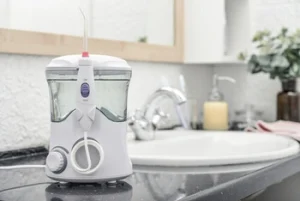
A water flosser uses a pressurised stream of water delivered through a nozzle or flosser tip. You fill a reservoir with water, select a pressure setting, and guide the tip along your gum line and between teeth. The water flow dislodges plaque and leftover food that brushing misses.
Most devices offer multiple pressure settings. Lower settings suit sensitive gums or early use, while higher pressure may be more effective for clearing debris around orthodontic hardware.
The ADA interdental cleaning guidance notes that while interdental cleaning remains an important part of daily oral health care, the right method depends on individual anatomy, dental work, and personal ability to use the tool consistently.
Is Water Flossing Enough on Its Own?
Water flossing is not a replacement for brushing. It works best as part of a complete oral hygiene routine that includes brushing with a manual toothbrush or sonic toothbrush, and in many cases, traditional flossing as well.
A systematic review and meta-analysis published in the International Journal of Dental Hygiene found that dental water jets used alongside a manual toothbrush may be an effective strategy for maintaining oral hygiene in orthodontic patients with gingivitis, though the authors noted that more high-quality trials are needed to confirm the findings. Individual outcomes vary, and no single cleaning method suits every patient.
For patients with braces, using a water flosser to flush debris from around orthodontic hardware, followed by careful brushing to remove remaining plaque from tooth surfaces and along the gum line, is a commonly recommended approach. Where possible, regular flossing using floss threaders or orthodontic-specific floss adds an additional layer of cleaning.
How to Use a Water Flosser With Braces
Using a water flosser correctly makes a noticeable difference in how well it cleans around orthodontic hardware.
Fill the reservoir with lukewarm water. Cold water can cause discomfort, particularly for patients with sensitive teeth or gums. Select a low-pressure setting initially and increase gradually as you become comfortable.
 Lean over the sink with the flosser tip in your mouth before switching on the device. This helps direct the water flow into the sink rather than across the mirror. Trace the tip along your gum line, pausing briefly between each tooth. Angle the tip toward the bracket on each tooth and allow the pressurised stream to clear debris from around the wire.
Work systematically from one side of the mouth to the other, covering both upper and lower teeth. Following your dentist’s daily teeth cleaning guidance alongside water flossing helps maintain thorough plaque removal from all tooth surfaces. The last thing to do after water flossing is to rinse your mouth and proceed to brushing.
If you use an orthodontic tip, follow the angle guidance included with the device. Keeping the tip perpendicular to the gum line works well for general cleaning, while angling it slightly toward the bracket helps clear debris from around orthodontic hardware.
A Considered Approach to Oral Hygiene During Orthodontic Treatment
Wearing braces changes what your oral hygiene routine needs to do. A water flosser may be a useful tool for managing plaque around brackets and wires, but how well it works depends on the device you choose, how consistently you use it, and how it fits into your broader routine.
If you are currently wearing braces or planning to start orthodontic treatment and want to understand which cleaning tools suit your situation, we welcome you to speak with our team at Good Choice Dental. Our dentists can assess your gum health and recommend an approach suited to your individual needs.
Call Good Choice Dental on (02) 8203 8760 or book an appointment online.
Frequently Asked Questions
How often should I use a water flosser with braces?
Using a water flosser once daily as part of your oral hygiene routine is a reasonable starting point, though your dentist may recommend a different frequency based on your gum health and the extent of your orthodontic work. Consistency of use tends to be more important than frequency alone.
 Is it safe to use a water flosser if my gums bleed?
Some bleeding when starting a new flossing routine can occur as gums adjust to more regular cleaning. If bleeding is minor and settles within a week or two, it is generally not a cause for concern. Persistent or heavy bleeding may indicate early gum disease and warrants a check with your dentist before continuing. Starting at the lowest pressure setting can help reduce irritation when gums are sensitive.
References
AlMoharib, H.S. (2024). ‘The effectiveness of dental water jet in reducing dental plaque and gingival bleeding in orthodontic patients: A systematic review and meta-analysis of randomized clinical trials’. International Journal of Dental Hygiene, 22. Hoboken, NJ: John Wiley and Sons. https://onlinelibrary.wiley.com/doi/abs/10.1111/idh.12741
Australian Dental Association. (n.d.). ‘Cleaning between the teeth’. Teeth.org.au. Sydney, NSW: Australian Dental Association. https://teeth.org.au/flossing
Healthdirect Australia. (2026). ‘Dental care and teeth cleaning’. Healthdirect Australia, 16 January. Sydney, NSW: Healthdirect Australia. https://www.healthdirect.gov.au/teeth-cleaning
Rădeanu, A.C., Surpățeanu, M., Munteanu, C.M., Liliac, I.M., Popescu, A.D., Andrei, E.C., and Pătru, C.L. (2024). ‘Periodontal changes induced by fixed orthodontic therapy’. Medicine and Pharmacy Reports, 97(3). Craiova, Romania: University of Medicine and Pharmacy of Craiova. https://pmc.ncbi.nlm.nih.gov/articles/PMC11370853/
Bad breath can be an uncomfortable and even embarrassing issue, but it's also incredibly common. Whether it's due to morning breath, certain foods, or underlying oral health issues, finding the best toothpaste for bad breath Read more

Have you ever wondered, 'Why is my mouth dry even though I drink a lot of water? ' You’re certainly not alone. Plenty of Australians deal with persistently dry mouths even when they stay well Read more
Poor oral hygiene may affect more than only the appearance of your teeth. Over time, poor dental hygiene may contribute to oral health problems involving the teeth, gums, and soft tissues inside the mouth. Many Read more
Recent Comments